
Cautionary Tales for the Aspiring Market Disruptor
David W. Myers (2023 January). BlueEcho Stategies.
Full Article Below
The Power of a True Market Disruptor
By definition, a Market Disruptor is a person or company that leads the fundamental transformation of an entire industry. That transformation can take the form of a vision for a new product or service or a new business model for delivering the value-chain. Market Disruptions, like political revolutions, can be messy and leave collateral damage. The end-result is intended to be innovation and greater value for the customer. It doesn’t always work out that way, but that is the general concept.
Whether you love them or hate them, Market Disruptors have brought us many things we take for granted in the 21st century. Amazon commercialized online retail. Apple brought us the modern smartphone. Netflix pioneered video-on-demand and streaming. Uber brought us ride share. Door Dash took food delivery beyond pizza. Tesla made the electric car a practical reality.
There are countless other examples, but in each case the new entrant fundamentally changed a product offering and/or how it was delivered to the end customer. The Market Disruptor breaks with convention and the established approach through genuine innovation. These market redefining innovations usually began with seemingly unlikely start-up companies.
The Risk Reward Trade-off of Agility
Start-up businesses are faster paced and more nimble than larger bureaucratic companies. There are fewer layers of management, which reduces decision time. There are fewer competing initiatives, so the entire team can focus on the development of a singular innovation.
Start-up companies, especially those funded privately or through venture capital, are unencumbered by the short-term earnings expectations of their publicly traded counterparts. Their boards of directors and investors often expect the business to lose money during the development phase. This provides more latitude to experiment and even make mistakes, presumably to learn quickly and take appropriate course corrections. Such freedom is absolutely essential to nurture product development and go-to-market creativity.
However, there is a flip side to this unstructured agility. It often means little to no oversight or corporate governance. The Board of Directors of the start-up may be composed of friends and family or unsophisticated investors, who trust the visionary CEO without question. Start-ups generally lack formal mechanisms for compliance or the checks and balances of established organizations. While the start-up can empower accelerated development, the lack of discipline and best practices creates a potential for catastrophic missteps. This all contributes to the increased risk reward ratio for the start-up investor.
Misadventures of Three Wayward Disruptors
To be the founder of a successful Market Disruptor is the penultimate business leadership experience. Yet to join the billionaire ranks of Steve Jobs, Jeff Bezos or Elon Musk requires extraordinary intellect, access to resources, and undeterred perseverance. To even think you might have what it takes, also requires and outsized sense of self-confidence.
We live in a time where the “Market Disruptor” is often revered like a modern-day knight in shining armor, leaping over the thorned thicket of industry convention and regulatory bureaucracy to bring the holy grail of innovation to the people. No doubt this view contributed to the misplaced trust in some recent dubious company executives.
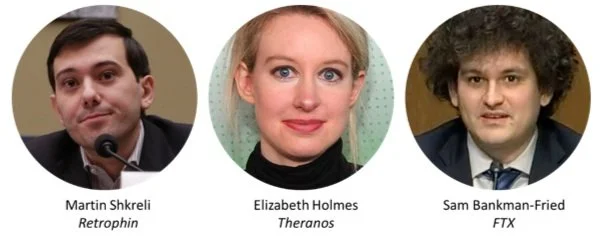
Martin Shkreli, the founder and CEO of former pharmaceutical company Retrophin, first attained infamy for jacking up the price of the HIV drug Daraprim from $13 a pill to a whopping $750 per pill. That is a more than 50 times or a 5,000% increase for no reason other than pure profiteering. But being a greedy anti-humanitarian is not a crime. It was securities fraud and breach of fiduciary responsibility that led to his 2017 conviction, a sentence of 7 years in prison, a $64M civil fine, and a ban for life from working in the pharmaceutical industry.
Elizabeth Holmes was fresh from dropping out of Stanford University when she founded the miracle medical machinery company, Theranos. After a dozen years in development and over $1 billion in investor funding, it became clear that there was nothing to show for all the effort. But failure to achieve audacious goals is not a crime. It was attempting to fake the results of the blood diagnostics and portraying the invention as a success, when it was in fact an utter failure, that led to a 2022 conviction of fraud and a sentence of 11+ years in prison.
Sam Bankman-Fried, founder of the now defunct crypto currency exchange FTX, has yet to complete his journey through the legal system, as of this writing. His interview on Good Morning America with George Stephanopoulos raised a lot of questions about why anyone would trust their money, or the management of a company, to someone with absolutely no executive presence. But extreme social awkwardness and a terrifically terrible haircut are not criminal. The tally of billions lost through the combination of incompetence and alleged embezzlement is still being counted. However, it seems fairly likely that Bankman-Fried will also become an extended stay guest of a federal penitentiary.
Shkreli, Holmes, and Bankman-Fried were all purported to be industry disruptors. They have been described by their followers and detractors alike as exceptionally brilliant and passionate about breaking from convention. They each wanted to compete in the billionaire business league and be seen as revolutionizing their respective industries. Yet this collection of convicted and presumptive felons also shared some more fore-telling attributes.
Hubris is No Substitute for Industry Experience
It takes more than dropping out of a top tier university and donning a black turtleneck to make a business leader. Raw intelligence and self-confidence are necessary, but not sufficient qualifications. All three of our wayward market disruptors were exceedingly inexperienced and undisciplined in the industries they had chosen to reimagine.
Shkreli was 28 years old when he founded Retrophin in 2011. With a business degree from Baruch College in 2004 Shkreli had pursued a career in securities trading and hedge fund management. He had no scientific background in the pharmaceutical arena. For Shkreli the actual product that a given company produces is of little interest. The company and its securities are merely the means by which to capture arbitrage on a financial transaction. In fact, Shkreli had a history of short selling stocks. That is the dubious, although not technically illegal, practice of betting on the failure rather than the success of a business. The scheme entails committing to sell stocks that you don’t actually own at their current price, assuming that you will be able to purchase that stock in the very near future at a lower price, as the company’s value declines. His ill-gotten gains using this tactic in the pharmaceutical space led to the foundation of Retrophin. It would be this Gordon Gecko style manipulation rather than a focus on any real value creation that would get him into trouble.
Holmes dropped out of Stanford at age 19, after only completing one year of college, when she founded Theranos. No degree and no experience in the medical devices industry. Her only relevant experience was a short-term internship in a laboratory that had introduced her to the collection and management of blood samples. Holmes appears to have held a genuine interest in the field of blood diagnostics. However, her primary focus seemed to be reinventing her image. She channeled Silicon Valley giants by oddly deepening her voice and yes frequently wearing a black turtleneck. In addition, Holmes honed her ability to serve-up a complex word salad of techno jargon that left even PhDs and research scientists baffled. Despite such preparations, Holmes was woefully unqualified to develop such a complex product, let alone run a pioneering scientific company.
Bankman-Fried was perhaps the closest to being qualified to run a company in his chosen field. Although only 27 years old at the time of FTX founding, Bankman-Fried had received a degree in Physics from Massachusetts Institute of Technology in 2014. He had worked for Jane Street Capital, a well-known global securities trading firm, initially as an intern and then full-time after graduation. Bankman-Fried left Jane Street, after less than three years to start his first company, Alameda Research in 2017. This is where he first began experimenting with crypto currency and formed the concept of what would become FTX.
With perhaps a touch more relevant experience than the other wayward disruptors, Bankman-Fried was hampered by his completely un-disciplined approach to management. Stories of his legendary “multi-tasking”, including playing video games while on investor calls and holding management meetings augmented with illegal substances, are emblematic of his lack of maturity. In addition, the crypto currency market is highly speculative and unregulated, generally accepted only for less reputable transactions. It is more akin to the gaming industry than legitimate securities trading. This wild west environment combined with Bankman-Fried’s man-child lack of discipline turned FTX into an even riskier gamble than its customers and investors could imagine.
While there certainly are extraordinarily intelligent people who can accomplish greatness at an early age, there is still no substitute for real-world experience. Their original motivations can be debated. But one thing is clear. None of these individuals had the domain expertise or business experience to run a multi-billion dollar company.
Defying Convention Not Ethics
Given their obvious inexperience, one might forgive Shkreli, Holmes, and Bankman-Fried for not personally understanding the legal intricacies of their respective markets. However, as the CEOs of their companies, they were still ultimately responsible.
Ignorance of the law is never an effective defense for breaking it. That is why you spend at least a little of your millions in seed money on a seasoned General Counsel and legal team. This investment is necessary to navigate current legal regulations, as well as anticipate the implications and consequences of the game changing tactics that a Market Disruptor may employ. For Retrophin, Theranos, and FTX the legal teams, at best, gave poor advice. Maybe they were pressured to fall in line and ignore the grey areas of ethics. At worst they were complicit in enabling fraud.
Overly eager to realize their dreams, perhaps these uninitiated business leaders unwittingly turned their desire to defy convention into a kind of willful ignorance of the rules. Some have argued that these defrocked corporate leaders were the victims of circumstance and were only convicted because the media turned on them. Their supporters argue that they simply got “in over their heads” and did not know how to recover, when plans went awry, or the product failed to perform. But if this wunderkind trio was smart enough to raise billions of dollars from investors and convince partners and customers to join their cause, they were surely smart enough to know when the path ahead was unsustainable.
At some point, they each made a conscious decision to cross the line. Presentations to industry analysts and investors transitioned from a “positive spin” of the facts to gross exaggeration and outright fabrication. The trio lacked the maturity and courage to come clean and face the consequences. Fickle media support or not, as the primary spokesperson for their respective companies, each of these CEOs made the choice to knowingly mislead their customers, employees, and investors. For that they have been held accountable.
Disruption for Disruption Sake
By attributing rock star status to early-stage Market Disruptors, the media often fuels the over blown sense of value that may, or more likely may not, materialize from the business idea du jour. Seemingly out of nowhere, these new CEOs become overnight billionaires, at least on paper, with the valuations of their companies soaring beyond reason. How could companies that are little more than a business plan and a website, with no workable product and no known path to profitability, suddenly become so artificially valuable? If the Market Disruptor CEO is young, attractive, or oddly eccentric the more addictively compelling the story, even if the business behind them is just smoke and mirrors.
Unfortunately, more often than not the aspiring Market Disruptor creates more havoc than actual value. Their supposed ground-breaking concepts can have a chilling effect on more evolutionary investment opportunities that have a higher likelihood of near-term success.
While the new entrepreneur blindly feels their way through the market in an effort to create their profound new innovation, traditional competitors may be forced to take defensive action against the hype. Customers may choose to hold off buying traditional proven products in the hope the disruptive new technology will be available as promised. Why buy a new solar power system if at-home cold fusion is just around the corner?
In practice, most new product development projects encounter numerous challenges. Market launches are frequently months or years later than promised. Conceptual features and benefits promoted as core to the new product may not make it into final production. All of that assumes the product ever successfully launches at all, since more than half of new businesses fail.
In the meantime, providers of more traditional products or services must explain to their investors how they will adapt to a threat that has yet to truly materialize. Traditional providers may be forced to cut R&D, and therefore reduce their own product innovation. When on the defense, prices are often the first thing to get cut, forcing artificial cost reductions to maintain profitability. Distribution channels and store fronts may be closed accompanied by employee lay-offs, all in reaction to the unrealized threat of the Market Disruptor.
Lessons for the Entrepreneur
For the would-be entrepreneur hoping to launch the next big thing, the lessons from recent failed Market Disruptors, may differ based on your experience. If you are a proven CEO, or happen to already be an internet billionaire, planning only to bet your own fortune and reputation on a risky new venture – more power to you.
If you are a college student or recent graduate planning to jump right into launching your dream company, take a beat. For every tale of a Bill Gates who drops out of Harvard to launch the next Microsoft there are hundreds of “self employed” 30-somethings still living in their parents’ basement. Their careers failed to launch, held back by lack of education, domain expertise, and real-world experience. For most people, you have lower odds of becoming the next billionaire market disruptor than your high school quarterback had of going pro in the NFL.
The best advice for the budding entrepreneur is first go to work for an industry-leading company in the field, even for just a few years. Learn best practices, as well as what you think can and should be done differently. Learn from the inside where the unmet market needs are and where things can be improved. If at all possible, adopt a mentor who has built a company and can help you navigate the often murky ethical boundaries of launching a pioneering business.
Finally, never allow yourself to get so caught up in your own vision and the need to defy convention, that you start believing you are invincible and no longer subject to the laws of ordinary mortals. Of course, if orange is your color and you like extreme minimalist concrete décor, perhaps you may be willing to take more risk than others.
Lessons for Stakeholders and the Board of Directors
For the investor, employee, or any other stakeholder in a self-proclaimed market disrupting company, the key lesson is to conduct your own due diligence. Don’t take everyone’s word for it that the founder is the next messiah. And don’t believe the media hype. Shkreli received some negative press early on, dubbed “Pharm Bro” for price gauging. But both Elizabeth Holmes and Sam Bankman-Fried became the darlings of the business press, receiving accolades and cover stories in Forbes, Fortune, Business Week and many more, before their dramatic falls from grace. Within a year, many of the same media outlets would be writing new articles about Holmes and Bankman-Fried, labelling them the biggest disappointments in business leadership history.
Even if the quirky visionary leader in the corner office is a genuine savant, they may have little more than a vague notion of the end game or how to get there. In short, they be making it up as they go along. Too often, we fall prey to group think and peer pressure, listening to techno jargon filled speeches, afraid to ask questions for fear of appearing out-of-touch. This is particularly profound when the visionary genius is one or more generations younger than the investors or other employees.
But a true leader should not be offended by earnestly asked questions, even if they seem basic in nature. A visionary should be confident enough to seek opportunities for peer review, as a means to pressure test their plan with constructive criticism.
The key lesson for the Board of Directors of a Market Disruptor is that you are accountable too. In this age of increasing transparency and accountability, the so-called corporate shield has worn quite thin. Directors of boards can be held personally and criminally liable for the misdeeds of their companies and management teams. It is your duty to provide oversight and ensure legal compliance through proper governance. Once a company reaches a certain level of outside investment or maturity, this may require an uncomfortable but necessary restructuring of the leadership team.
The technical or commercial insights of the founder may be better channeled in a dedicated role as a Chief Technology or Chief Product Officer, perhaps even an Executive Chairman role on the board. Being the world’s best baseball player, doesn’t mean you know how to effectively manage a team franchise. By all means, the founder should benefit from their intellectual property and retain an appropriate level of equity ownership and even control over the strategic direction of the business. It was after-all their idea. But at some point, the company will need a professional Chief Executive Officer or President, who is experienced and proven in running complex and rapidly growing companies. The Board must ensure that it doesn’t lose the entrepreneurial spirit of the founder, while simultaneously ensuring that the company is run above board and establishes the best practices and checks and balances expected of a multi-billion dollar organization.
Final Word: There are No Short Cuts to Greatness
True innovation requires a long-term vision, creative thinking, calculated risk taking, real perseverance and sometimes a dramatic divergence from industry norms. To be clear, defying convention alone is not in and of itself of value. Bending or breaking the rules is easy. Yet all too often the disruption itself gets romanticized, when it should merely be the by-product of achieving genuine innovation.
###
References
Porterfield, C. (2022 January). “Pharma Bro” Martin Shkreli hit with $64.6 million fine and lifetime ban. Forbes.
FORBES | ‘Pharma Bro’ Martin Shkreli Hit With $64.6 Million Fine And Lifetime Ban
Liedtke, M. (2022 November). Former Theranos CEO Elizabeth Holmes sentenced to 135 months in prison. Fortune.
FORTUNE | Former Theranos CEO Elizabeth Holmes sentenced to 135 months in prison
Nicolle, E. (2023 September) What went wrong at FTX and what does Sam Bankman-Fried say? Bloomberg.
BLOOMBERG BUSINESSWEEK | What Went Wrong at FTX and What Does Sam Bankman-Fried Say?