
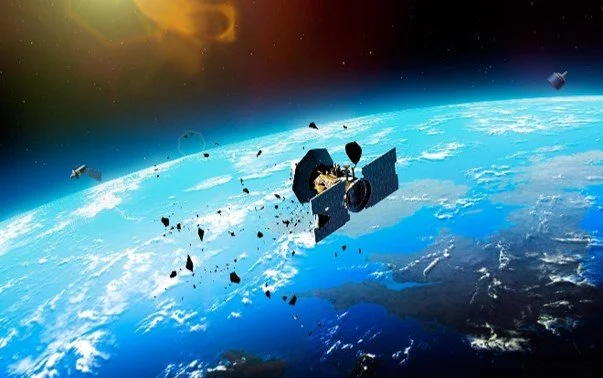
Orbital Debris Mitigation Concepts & Cost Estimation: Laser Enabled Remediation Spacecraft
David Myers (2024 July). Embry-Riddle Aeronautical University
Full Article Link Below
Abstract
Space is often thought of as a vast open vacuum, but certain areas within Earth’s sphere of influence are becoming increasingly crowded with defunct spacecraft and orbital debris. This presents a significant and growing hazard to current and future space operations. Since the beginning of the 21st century, humans have increased the number of artificial spacecraft in orbit from just a few hundred to nearly ten thousand. These spacecraft provide many critical everyday services of modern civilization, that we take for granted. Satellites are an essential part of the backbone of global communications. Satellite constellations like NAVSTAR GPS and Galileo provide critical positioning, navigation, and timing services for commercial airlines, ships at sea, and road navigation. GPS receivers are ubiquitously integrated into passenger vehicles, cellular phones, and personal electronics. Space-based weather monitoring provides forecasts for both major storms and the long-term effects of climate change. Earth observation and remote sensing satellites provide intelligence and advanced warning for both naturally occurring events like wildfires and human-made threats like military movements.
Despite our increasing dependence on these indispensable satellite capabilities, rapid growth in the access to space is creating an undesirable by-product of “space junk.” In addition to tens of thousands of defunct satellites and discarded rocket components, there are over 130 million bullet-sized fragments of space shrapnel travelling at hyper-velocities around the planet. With tremendous kinetic energy, each one represents a potential catastrophic impact to an operating satellite or human crewed spacecraft.
This research paper explores some of the leading orbital debris mitigation technologies currently being assessed by NASA, ESA, and the commercial space industry. A specific concept of operations, utilizing laser or directed energy technology is defined and compared to other potential approaches. As part of the research, a cost estimate is presented for the development of two conceptual Laser Orbital Debris Remediation Spacecraft (LODRS), enabled with a directed energy system capable of mitigating multiple types of space debris in low Earth orbit.